Business Moats: What Makes a Company Difficult to Compete With?
A successful company does not become difficult to compete with simply because it has a popular product. Competitors can often copy products, reduce prices or launch similar services.
What makes some businesses more difficult to challenge is the presence of lasting competitive advantages.
These advantages are often called business moats.
The term comes from the defensive moat surrounding a castle. In business, a moat represents something that protects a company from competitors and helps it maintain its market position over time.
What Is a Business Moat?
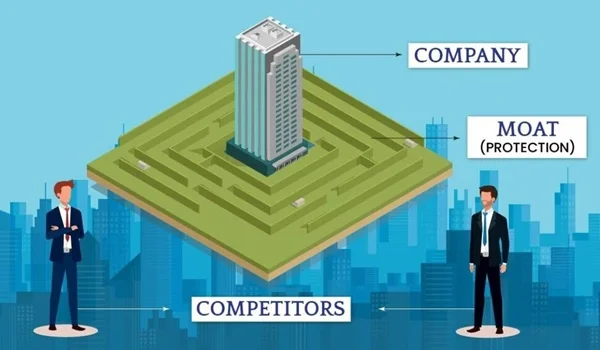
A business moat is a structural advantage that makes it difficult for competitors to take customers, reduce margins or replicate the company’s position.
A strong moat can help a company maintain:
- Customer loyalty
- Market share
- Pricing power
- Profit margins
- Distribution advantages
- Long-term growth
Not every successful business has a strong moat. A company can grow quickly without having anything that prevents competitors from eventually copying its success.
Brand Strength
A powerful brand can become one of the strongest competitive advantages.
Customers may choose a familiar brand even when competing products are cheaper or similar in quality.
A strong brand can create:
- Customer trust
- Recognition
- Loyalty
- Pricing power
- Lower customer acquisition costs
For example, customers may be willing to pay more for a trusted brand because they associate it with quality or reliability.
However, simply being famous does not necessarily create a moat. The brand must influence purchasing decisions in a meaningful way.
Network Effects
A network effect occurs when a product or service becomes more valuable as more people use it.
Social networks are a simple example.
A social platform with millions of users can be more attractive to new users because their friends, colleagues or communities are already there.
This creates a difficult situation for competitors.
A new platform may offer good technology, but convincing users to leave an established network can be extremely difficult.
Network effects can therefore become powerful barriers to competition.
Switching Costs
Switching costs occur when customers face financial, operational or practical difficulties when moving from one provider to another.
For example, a company using specialized business software may have:
- Employee training invested in the system
- Historical data stored there
- Existing integrations
- Established workflows
Moving to another system may require significant time and money.
The customer may therefore remain with the existing provider even if competitors offer similar products.
Cost Advantages
Some companies can operate at lower costs than competitors.
This can happen because of:
- Economies of scale
- Efficient supply chains
- Better technology
- Lower production costs
- Exclusive supplier relationships
- Operational expertise
A company with a structural cost advantage can potentially offer lower prices while maintaining acceptable margins.
Competitors may struggle to match those prices without losing money.
Distribution Advantages
Having strong distribution can also create a moat.
A company may have relationships with:
- Retailers
- Wholesalers
- Dealers
- Logistics providers
- Online marketplaces
- Corporate buyers
Building a comparable distribution network can take years.
A competitor may have an excellent product but still struggle to reach customers at the same scale.
Patents and Intellectual Property
Intellectual property can create legal barriers to competition.
Patents may prevent competitors from commercially using certain inventions for a defined period, subject to applicable law.
Other forms of intellectual property include:
- Trademarks
- Copyrights
- Trade secrets
- Proprietary technology
Intellectual property is particularly important in industries where developing a competing product requires significant research and development.
However, patents eventually expire, and competitors may sometimes develop alternative technologies.
Data Advantages
Some technology companies can build advantages through large amounts of proprietary data.
More data can potentially improve:
- Algorithms
- Personalization
- Forecasting
- Fraud detection
- Product recommendations
- Customer insights
If the data is difficult for competitors to replicate, it can become part of the company’s competitive advantage.
However, having a large amount of data alone does not automatically create a moat. The company must be able to turn that data into better products or economics.
Economies of Scale
Large businesses may benefit from lower average costs because they operate at greater scale.
They may negotiate better prices from suppliers, spread technology costs across more customers and operate large distribution networks efficiently.
This can create a cycle:
More customers → greater scale → lower costs → better prices or margins → stronger competitiveness
When competitors cannot achieve the same scale, the advantage can become difficult to overcome.
Regulatory or Licensing Barriers
Some industries have significant regulatory requirements.
Entering sectors such as banking, telecommunications, pharmaceuticals or certain infrastructure businesses may require:
- Licences
- Regulatory approvals
- Large capital investments
- Compliance systems
- Specialized expertise
These requirements can make market entry more difficult.
However, regulatory protection is not always permanent. Regulations can change, and new technologies can alter competitive conditions.
Customer Relationships
Long-term customer relationships can also become a competitive advantage.
A company that has worked with customers for many years may understand their:
- Requirements
- Purchasing patterns
- Operational processes
- Preferences
- Business challenges
A new competitor may offer a lower price but still struggle to replace an established relationship.
This is especially important in industries where trust and reliability matter.
Business Moats vs Temporary Advantages
Not every advantage is a moat.
A temporary advantage might include:
- A viral marketing campaign
- A short-term discount
- A popular product trend
- Temporary supply shortages
- A celebrity endorsement
These can produce strong results but may disappear quickly.
A genuine moat should ideally be difficult to replicate and durable over time.
Comparing Major Business Moats
| Type of Moat | Why It Helps | Difficulty for Competitors |
| Brand | Creates trust and loyalty | High if deeply established |
| Network effects | More users increase value | Very high in strong networks |
| Switching costs | Makes customers reluctant to leave | High |
| Cost advantage | Enables lower costs or higher margins | High |
| Distribution | Provides better market access | High |
| Intellectual property | Creates legal or technical barriers | Depends on protection |
| Data | Can improve products and decisions | Depends on data uniqueness |
| Scale | Reduces average costs | High in capital-intensive industries |
| Regulation | Limits market entry | Depends on regulations |
| Customer relationships | Encourages retention | High in relationship-driven markets |
Can a Business Have Multiple Moats?
Yes.
The strongest companies may have several competitive advantages working together.
For example, a company might have:
Strong brand + large customer base + network effects + low operating costs
Each advantage reinforces the others.
This can make the business significantly more difficult to challenge than a company relying on only one advantage.
Why Moats Can Disappear
A moat is not permanent.
Technology can change industries, customer preferences can shift and new competitors can develop better business models.
A company that once dominated through physical distribution may lose that advantage when customers move online.
Similarly, a technology advantage can disappear when competitors develop superior technology.
Therefore, companies need to continuously strengthen their competitive advantages.
How to Recognize a Strong Moat
A useful question is:
“What prevents another well-funded company from copying this business?”
If the answer is simply:
“We have a good product.”
the moat may be weak.
But if the answer involves millions of loyal customers, significant switching costs, proprietary technology, powerful distribution, network effects or structural cost advantages, the competitive position may be stronger.
Final Thoughts
Business moats help explain why some companies remain successful for decades while others lose market share soon after competitors enter their industry.
A strong moat can come from brand strength, network effects, switching costs, cost advantages, distribution, intellectual property, data, scale, regulation or customer relationships.
The most valuable moats are generally those that are difficult to copy and continue providing an advantage as the company grows.
Ultimately, a company’s long-term strength is not determined only by how good its product is today. It also depends on what makes that position difficult for competitors to take tomorrow.