What Happens After IPO Allotment? Complete Process from Allotment to Listing
Getting an IPO allotment is an important step, but the IPO process does not end when an investor sees the word “Allotted” on the allotment status page. Several steps still take place before the shares become available for trading on the stock exchange.
After allotment, the process generally includes finalization of the basis of allotment, adjustment of application money, unblocking of excess funds, credit of shares to the demat account, listing approval and commencement of trading.
For public issues under the current framework, the listing timeline is generally based on a T+3 working-day cycle, where T refers to the issue closing date. The exact dates for allotment, unblocking, demat credit and listing are provided in the IPO’s issue schedule.
Understanding what happens after IPO allotment can help investors know when their shares should appear in the demat account, when blocked money should become available and when they can start trading.
What Happens Immediately After IPO Allotment?
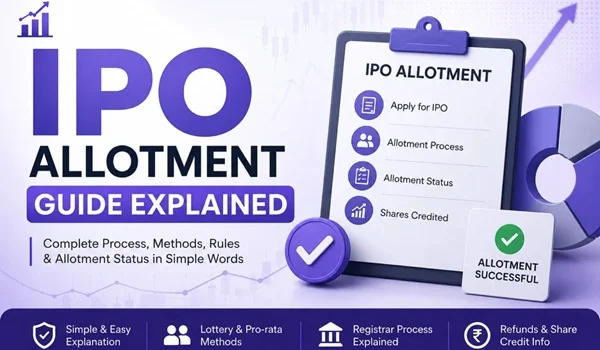
Once the IPO closes, the registrar processes all valid applications and prepares the basis of allotment.
The broad sequence is:
IPO closes → Basis of allotment → Allotment status → Fund adjustment → Demat credit → Listing approval → Listing → Trading
The process involves the company, registrar, stock exchange, banks, depositories and other intermediaries.
An investor generally does not need to manually complete each step. Most of the processing takes place electronically between the concerned intermediaries.
Step 1: Basis of Allotment Is Finalized
The first important step after the IPO closes is determining who receives shares.
If an IPO is oversubscribed, there may be more applications than shares available in a particular category. The registrar applies the applicable allotment methodology to determine the successful applicants and the number of shares allotted.
The basis of allotment is finalized in coordination with the relevant parties and approved through the prescribed process.
This is why investors cannot know their final allotment merely from the number of shares they applied for.
Example
Suppose an investor applies for:
100 shares
But the retail portion receives significantly more applications than the shares available.
The investor may receive:
20 shares
or, depending on the allotment process, a different quantity or no shares at all.
The final quantity is determined only after the basis of allotment is finalized.
Step 2: IPO Allotment Status Becomes Available
After the basis of allotment is finalized, investors can check their individual allotment status.
The status may indicate:
- Shares allotted
- No shares allotted
- Partial allotment
- Application rejected or otherwise not considered
Investors should check the exact quantity rather than simply looking for an “Allotted” message.
For example:
Applied: 100 shares
Allotted: 25 shares
In this case, the investor has received a partial allotment.
Step 3: Money for Allotted Shares Is Adjusted
IPO applications generally involve blocking funds rather than immediately transferring the entire application amount to the company.
Once allotment is finalized, the amount required for the shares actually allotted is adjusted according to the applicable process.
For UPI-based applications, the amount corresponding to the allotment is debited from the blocked funds and the excess amount is unblocked.
For ASBA applications, the relevant amount remains blocked or is debited as required, while the unused amount is released.
Example
Suppose:
IPO application amount = ₹1,00,000
The investor receives shares worth:
₹20,000
The remaining:
₹80,000
is the excess amount that should be released according to the applicable process.
Step 4: Excess IPO Money Is Unblocked
If the investor receives only part of the applied shares or no shares, the amount not required for allotment is unblocked.
This is different from a traditional refund in which money is necessarily transferred back through a separate credit transaction.
With ASBA or UPI mechanisms, the investor’s funds may simply become available again after the block is removed.
Investors should therefore check their available bank balance and blocked amount, rather than looking only for a separate “IPO refund” credit.
Step 5: IPO Shares Are Credited to the Demat Account
Investors who receive shares have the allotted securities credited electronically to the demat account specified in the IPO application.
Physical share certificates are not issued for these equity shares.
The credit normally takes place before the listing date according to the issue schedule.
Investors may receive a notification from their depository or other intermediary when the shares are credited.
Important Point
The shares may be credited to the demat account before they become visible in every section of the broker’s trading application.
Therefore, if the allotment is confirmed but the broker app does not immediately show the shares, investors should check the actual demat statement as well.
Step 6: Check Your Demat Account
After allotment, investors should verify:
- Company name
- Number of shares
- Demat account
- Credit entry
- Security identifier, where displayed
If the shares appear in the demat statement, the credit has taken place even if the broker’s portfolio page has not yet updated.
If the shares do not appear within the applicable schedule, the investor should contact the relevant broker, Depository Participant or IPO registrar, depending on the nature of the issue.
Step 7: Listing and Trading Approval
After the shares are credited and the necessary processes are completed, the stock exchange provides the applicable listing and trading approval.
The company then becomes a listed security on the exchange.
Listing is different from allotment.
Allotment: Determines how many shares an investor receives.
Demat credit: Puts those shares into the investor’s demat account.
Listing: Makes the company’s shares available on the stock exchange.
Trading: Allows investors to buy or sell the listed shares through the exchange, subject to the applicable trading rules.
Step 8: IPO Shares Are Listed on the Stock Exchange
On the scheduled listing date, the company’s shares become available for trading on the stock exchange.
The listing price is not necessarily equal to the IPO issue price.
For example:
IPO issue price = ₹500
The shares could begin trading at:
₹550
or:
₹470
depending on market demand and supply and the applicable price-discovery mechanism.
Therefore, receiving an IPO allotment does not guarantee a listing gain.
Step 9: Trading Starts
Once trading begins, investors can see the newly listed shares in their trading account and can place orders according to the normal market process.
The market price can move above or below the IPO issue price after listing.
Investors should therefore understand that the IPO application stage and the post-listing trading stage involve different risks.
IPO Allotment to Listing: Simple Timeline
For a standard public issue following the current T+3 framework, the broad process can be understood as follows:
| Stage | Approximate Process |
| T | IPO closes |
| After closure | Application reconciliation and processing |
| Next stages | Basis of allotment is finalized |
| After allotment | Allotment status becomes available |
| Around the same period | Funds are adjusted and excess amount is unblocked |
| Before listing | Allotted shares are credited to demat accounts |
| T+3 | Listing generally takes place under the applicable framework |
| After listing | Trading begins |
The exact date for each step can vary depending on the issue schedule, weekends, holidays and applicable processing requirements.
What Happens If You Do Not Get an IPO Allotment?
If an investor does not receive any shares, there is no share credit to the demat account.
Instead, the application amount that was not required for allotment is unblocked.
For example:
Application amount: ₹50,000
Shares allotted: 0
Amount required for shares: ₹0
Amount to be unblocked: ₹50,000
The investor should check the bank account or UPI mandate to confirm that the blocked amount has been released.
What Happens in Partial IPO Allotment?
Partial allotment is common in highly subscribed IPOs.
Suppose an investor applies for 200 shares at ₹500 each.
Total application amount = ₹1,00,000
After allotment, the investor receives 20 shares.
Value of allotted shares = ₹10,000
The remaining:
₹90,000
should be unblocked according to the applicable IPO process.
The investor should therefore not expect the full ₹1,00,000 to return to the bank account because ₹10,000 is required for the shares actually allotted.
What Happens If IPO Shares Are Not Visible in the Broker App?
There can be a short delay between actual demat credit and visibility in a broker’s application.
If the allotment status shows shares have been allotted, follow these steps:
- Check the actual demat statement.
- Check whether a depository credit notification has been received.
- Confirm the allotted quantity.
- Check the broker’s holdings section.
- Wait for the relevant processing update if the scheduled credit time has not passed.
- Contact the broker or DP if the shares are credited to the demat account but remain invisible in the trading platform.
- Contact the IPO registrar if the securities have not been credited despite confirmed allotment and the applicable timeline having passed.
What Happens to the IPO Money After Allotment?
The treatment of money depends on the allotment.
Full Allotment
The amount required for all allotted shares is adjusted.
Partial Allotment
The amount required for the allotted shares is retained or debited, while the excess amount is unblocked.
No Allotment
The application amount is unblocked according to the applicable process.
This is why investors should compare the allotment quantity with the application amount before assuming there is a refund problem.
What Is the Difference Between Allotment Date and Listing Date?
These dates represent different events.
Allotment Date
This is when the basis of allotment is finalized and investors can determine whether they received shares.
Demat Credit Date
This is when the allotted shares are electronically credited to the investor’s demat account.
Listing Date
This is when the shares are admitted for trading on the stock exchange.
These events can occur close together, but they are not the same thing.
What Should Investors Check After IPO Allotment?
Once shares are allotted, investors should check:
- Allotment Quantity
Confirm exactly how many shares were allotted.
- Bank Account
Check whether excess blocked funds have been released.
- UPI Mandate
If the application was made through UPI, check the status of the IPO mandate.
- Demat Account
Confirm that the allotted shares have been credited.
- Broker Account
Check whether the shares are visible in the holdings section.
- Listing Date
Note the scheduled listing date.
- Issue Price
Keep the IPO issue price available for comparison with the market price after listing.
Common Mistakes After IPO Allotment
Assuming Allotted Shares Mean Guaranteed Profit
Allotment only means the investor has received shares. It does not guarantee a profit.
Checking Only the Broker App
A broker application may take some time to display newly credited securities. The demat statement provides another way to verify the actual credit.
Confusing Partial Allotment With a Refund Problem
If only some shares are allotted, part of the application amount will remain invested in the IPO.
Expecting the Listing Price to Equal the Issue Price
The listing price is determined through the applicable market mechanism and can differ from the IPO issue price.
Ignoring the Listing Date
Investors should know when the shares are scheduled to begin trading rather than assuming that allotment automatically means immediate trading.
Simple Example: From IPO Application to Listing
Suppose Priya applies for an IPO:
Application: 100 shares
Bid price: ₹300 per share
Application amount: ₹30,000
After the IPO closes, the basis of allotment is finalized.
Priya receives:
Allotted shares: 20
Therefore:
Amount required = 20 × ₹300 = ₹6,000
The remaining:
₹30,000 − ₹6,000 = ₹24,000
is released according to the applicable fund-unblocking process.
The 20 shares are then credited to Priya’s demat account.
On the scheduled listing date, the shares become available for trading.
If the shares begin trading at ₹340, the market value at that price would be:
20 × ₹340 = ₹6,800
However, the market price can move in either direction after listing.
IPO Allotment to Listing: Complete Process at a Glance
The entire process can be remembered with this simple flow:
IPO Closes
↓
Applications Are Reconciled
↓
Basis of Allotment Is Finalized
↓
Allotment Status Is Published
↓
Funds Are Adjusted
↓
Excess Funds Are Unblocked
↓
Allotted Shares Are Credited to Demat
↓
Listing Approval Is Completed
↓
Shares Are Listed
↓
Trading Begins
This process normally happens electronically, so investors usually do not need to submit separate instructions after a successful IPO application.
Frequently Asked Questions
What happens after IPO allotment?
After allotment, the application money is adjusted, excess funds are unblocked, allotted shares are credited to the demat account and the company proceeds toward listing and trading approval.
When are IPO shares credited to the demat account?
The shares are generally credited before the scheduled listing date. The exact timing depends on the particular IPO’s issue schedule.
What happens if I get no IPO allotment?
If no shares are allotted, the application amount that was blocked for the IPO is released according to the applicable process.
What happens after partial allotment?
The amount required for the shares allotted is retained or debited, while the excess application amount is unblocked.
Can I sell IPO shares immediately after allotment?
Allotment alone does not mean the shares are immediately tradable. The shares must be credited and the security must be listed and available for trading.
Is IPO allotment the same as listing?
No. Allotment determines how many shares an investor receives, while listing makes those shares available for trading on the stock exchange.
Can the IPO list below its issue price?
Yes. The listing price can be below, equal to or above the IPO issue price depending on market conditions and demand and supply.
What if my allotted IPO shares are not visible in my demat account?
First check the allotment status and demat statement. If the applicable credit timeline has passed and the shares are still missing, contact the IPO registrar or Depository Participant with the application and demat details.
Final Takeaway
IPO allotment is only one stage of the public issue process. After investors receive an allotment, the remaining steps include fund adjustment, unblocking of excess money, demat credit, listing approval and commencement of trading.
Under the current framework, public issues generally follow a T+3 working-day listing timeline, with T representing the issue closing date. The specific IPO schedule should always be checked for the exact dates.
Investors should carefully verify their allotment quantity, bank balance, UPI mandate, demat credit and listing date. Most importantly, receiving an IPO allotment does not guarantee a listing gain or future profit. Once the shares are listed, their market value will depend on trading demand, company performance and broader market conditions.