Breach of Contract vs Breach of Promise: Why the Difference Matters
People often use the words “promise” and “contract” as if they mean the same thing.
They do not.
A person can make a promise without creating a legally enforceable contract. On the other hand, when a legally valid contract exists and one party fails to perform an obligation required by that contract, the failure may amount to a breach of contract.
This distinction matters because not every broken promise gives the other person a legal right to sue for breach of contract.
What Is a Promise?
A promise is generally an assurance or commitment that someone will do something or refrain from doing something.
For example:
“I will deliver the equipment next week.”
That statement may be a promise, but whether it creates a legally enforceable obligation depends on the surrounding circumstances and applicable law.
Factors such as intention, consideration, contractual terms and the legal relationship between the parties can matter.
What Is a Contract?
A contract is a legally enforceable agreement.
Depending on the jurisdiction, a valid contract generally requires elements such as:
- Agreement between the parties
- Offer and acceptance or another legally recognised method of agreement
- Consideration, where required
- Intention to create legal relations
- Capacity
- Lawful purpose
- Sufficiently certain terms
The precise requirements vary by jurisdiction.
Therefore:
Every contract contains legally relevant promises or obligations, but not every promise creates a contract.
What Is a Breach of Contract?
A breach of contract occurs when a party fails to perform an obligation required by a legally enforceable contract.
Examples can include:
- Failing to deliver goods
- Failing to pay an agreed amount
- Delivering goods that do not meet contractual specifications
- Missing a contractual deadline
- Refusing to perform an agreed service
Whether a particular failure constitutes a breach depends on the actual terms of the contract and applicable law.
What Is a Breach of Promise?
The phrase “breach of promise” can have different meanings depending on context.
In ordinary language, it simply means that someone failed to keep a commitment.
Legally, however, the phrase does not automatically establish a claim for breach of contract.
A person must identify the legal basis for enforcing the promise.
For example, the promise may be:
- Part of a contract
- Supported by another enforceable legal doctrine
- Merely a personal commitment with no contractual remedy
The legal consequences can therefore be very different.
The Main Difference
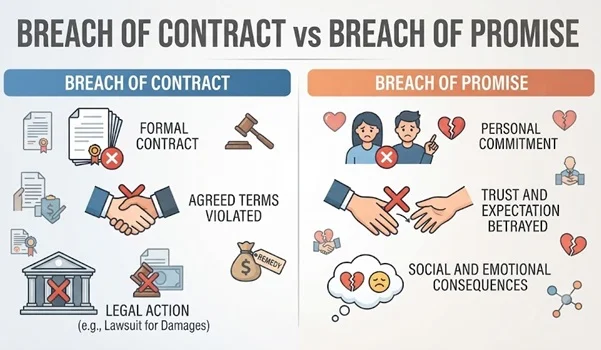
The simplest distinction is:
Breach of contract → Failure to perform a legally enforceable contractual obligation.
Breach of promise → Failure to keep a commitment, which may or may not create an enforceable legal claim.
This is why calling something a “broken promise” is not enough to establish a breach-of-contract case.
A Simple Example
Imagine a business agrees in writing to sell 1,000 units of a product to another business for ₹5 lakh.
The buyer pays according to the agreed terms.
The seller then refuses to deliver the goods without a contractual justification.
This is potentially a breach of contract because there is an enforceable agreement and an obligation to deliver.
Now consider a friend saying:
“I promise I’ll help you move house next Saturday.”
If the friend does not show up, the promise may be broken in an everyday sense.
But that does not automatically create a contractual claim.
The legal context is completely different.
Why the Contract Matters
A contract establishes the legal relationship between the parties.
It can specify:
- What each party must do
- When performance is due
- How payment will occur
- What happens after a breach
- Whether notice must be given
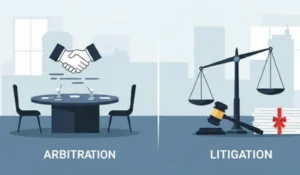
- Whether disputes go to arbitration or court
- Whether limitations or exclusions apply
Without an enforceable contract, these contractual rights and remedies may not exist.
Not Every Contract Breach Is Intentional
A breach does not necessarily require someone to deliberately break their promise.
For example, a supplier may fail to deliver because of:
- Administrative error
- Operational problems
- Miscommunication
- Failure to arrange transport
- Other circumstances
Whether the failure constitutes a breach depends on the contract and applicable law.
The reason for the failure may affect available defences or remedies.
Anticipatory Breach
Sometimes a party indicates before the performance deadline that they will not perform their contractual obligation.
This may be known as an anticipatory breach or repudiation, depending on the applicable legal system.
For example:
A supplier agrees to deliver goods on December 1.
On November 15, the supplier clearly states that it will not deliver them.
The other party may have legal rights arising from that repudiation, subject to the applicable law and contract terms.
Partial Breach
A party may perform part of its contractual obligations while failing to perform another part.
For example:
A contractor agrees to complete five specified tasks but completes only four.
Whether this amounts to a breach, and what remedies are available, depends on the contract and the significance of the incomplete obligation.
Material Breach
Some breaches are more significant than others.
A material breach generally refers to a breach serious enough to substantially affect the contractual bargain.
For example, receiving a completely different product from the one contracted for may be materially different from receiving the correct product with a minor packaging defect.
The legal consequences depend on the jurisdiction and contract.
Minor Breach
A relatively minor contractual failure may not justify terminating the entire agreement.
For example, a contract might require a report by Monday, and the report is delivered Tuesday without causing significant harm.
The exact consequences depend on the contractual terms and applicable law.
This is why it is important to distinguish between the existence of a breach and the remedy available for that breach.
Remedies for Breach of Contract
Depending on the jurisdiction and circumstances, remedies can include:
Damages
Financial compensation for legally recognised loss caused by the breach.
Specific Performance
A court may, in appropriate circumstances, order a party to perform its contractual obligation.
Injunction
A court may order a party to do or refrain from doing something where legally appropriate.
Rescission or Termination
Certain circumstances may allow a contract to be ended or set aside according to applicable law.
The availability of each remedy depends on the facts and legal framework.
A Broken Promise May Have No Contractual Remedy
Suppose someone tells a neighbour:
“I’ll sell you my old laptop next month for ₹20,000.”
The neighbour may rely on the statement, but whether there is an enforceable contract depends on the circumstances.
If the necessary elements of a contract are absent, simply describing the statement as a “promise” does not automatically create a contractual right.
When a Promise Can Become Contractually Binding
A promise can form part of an enforceable contract when the necessary legal requirements are satisfied.
For example:
A company agrees to provide consulting services for ₹2 lakh.
The client agrees to pay the stated amount.
The parties agree on the essential terms.
If the agreement is legally enforceable and the company refuses to provide the services contrary to the contract, the failure can constitute a breach of contract.
The important point is not merely that a promise was made.
It is that the promise became part of a legally enforceable agreement.
Written vs Oral Agreements
A contract does not always have to be written.
Depending on the applicable law, some contracts can be formed orally or through conduct.
However, certain types of agreements may be required by law to satisfy particular formal requirements.
Written contracts are often easier to prove because the parties can refer to the agreed terms.
Why Evidence Matters
If someone claims that a promise was legally binding, the court may need to examine evidence such as:
- Written agreements
- Emails
- Messages
- Invoices
- Payment records
- Witness testimony
- Business communications
- Conduct of the parties
The evidence can help establish what was agreed and whether a legally enforceable obligation existed.
Contract Terms Can Limit the Consequences
A contract may contain provisions dealing with breach.
For example, it may specify:
- Notice requirements
- Cure periods
- Liquidated damages
- Termination rights
- Dispute resolution
- Arbitration
- Limitations of liability
These provisions can significantly affect what happens after an alleged breach.
However, their enforceability depends on applicable law.
Breach of Contract vs Breach of Promise
| Feature | Breach of Contract | Breach of Promise |
| What is broken? | Contractual obligation | A commitment or promise |
| Legally enforceable? | Generally, if a valid contract exists | Not automatically |
| Requires contract? | Yes | Not necessarily |
| Can lead to damages? | Yes, where legally available | Only if a recognised legal claim exists |
| Can lead to termination? | Potentially, depending on breach and contract | Not in the contractual sense unless a contract exists |
| Importance of contract terms | Very high | Depends on the legal context |
The Difference Between Contractual and Personal Promises
Personal promises are common in everyday life.
Someone may promise:
- To attend an event
- To help a friend
- To return a personal item
- To meet someone at a particular time
Breaking such a promise can have personal consequences, but it does not automatically create legal liability.
Contracts operate differently because the parties enter into a relationship that the law recognises as legally enforceable.
A Promise Can Also Raise Other Legal Issues
Even when there is no traditional contract, certain promises or representations may potentially create other legal consequences depending on the circumstances.
For example, legal systems may recognise doctrines involving:
- Promissory estoppel
- Misrepresentation
- Reliance
- Unjust enrichment
These doctrines have specific requirements and should not be treated as automatic alternatives to contract law.
Why the Distinction Matters in Business
Businesses make thousands of commitments through:
- Purchase orders
- Service agreements
- Employment agreements
- Distribution arrangements
- Franchise agreements
- Vendor contracts
- Partnership agreements
When a dispute arises, the key question is often not:
“Was a promise made?”
It is:
“What legal obligation did the parties create, and what are the consequences of failing to perform it?”
Final Thoughts
A broken promise and a breach of contract are not automatically the same thing.
A promise becomes legally significant as a contractual obligation when the requirements for an enforceable contract are satisfied.
If a party then fails to perform that obligation, the other party may have a claim for breach of contract and potentially seek remedies such as damages, specific performance or other relief.
The key takeaway is:
A promise describes a commitment; a contract creates legally enforceable obligations.
Therefore, when evaluating an alleged breach, the most important questions are whether a valid contract existed, what its terms required, whether those terms were breached and what remedies the applicable law provides.