Reducing Balance vs Flat Interest Rate: Why the Same Rate Can Cost Differently
When comparing loans, borrowers often look at the interest rate first. But the rate alone does not always tell you how much a loan will actually cost.
Two loans may both advertise an interest rate of 10% per year, yet the total interest paid can be significantly different if one uses a reducing balance method and the other uses a flat interest rate.
The reason is simple: the interest is calculated on different amounts.
What Is a Reducing Balance Interest Rate?
Under the reducing balance method, interest is calculated on the outstanding principal.
As the borrower makes repayments, the principal gradually decreases. Therefore, the interest charged in subsequent periods is calculated on a smaller balance.
For example, suppose a borrower takes a ₹1 lakh loan.
At the beginning, interest is calculated on the outstanding ₹1 lakh.
After part of the principal has been repaid, the outstanding balance may fall to ₹90,000.
The next interest calculation is based on the applicable outstanding balance rather than the original ₹1 lakh.
This is why it is called a reducing balance method.
What Is a Flat Interest Rate?
Under a flat interest method, the interest is generally calculated on the original principal amount throughout the stated loan period, rather than recalculating interest on the declining outstanding balance.
For example, if a ₹1 lakh loan carries a flat annual rate of 10%, the interest calculation may continue to use ₹1 lakh as the base even after the borrower has repaid part of the principal.
This can make the effective cost of borrowing considerably higher than the advertised flat rate might suggest.
The exact calculation depends on the loan agreement.
Why the Same Rate Can Cost More
Consider a simplified example.
Suppose:
- Loan amount: ₹1,00,000
- Interest rate: 10% per year
- Tenure: 2 years
With a flat rate, annual interest could be calculated as:
₹1,00,000 × 10% = ₹10,000
For two years:
₹10,000 × 2 = ₹20,000
The total repayment would therefore be:
₹1,20,000
This is a simplified illustration and does not account for fees or other charges.
With a reducing balance loan, interest is calculated on the outstanding principal, so the total interest would generally be lower for the same nominal rate and repayment structure.
The Difference Comes From the Interest Base
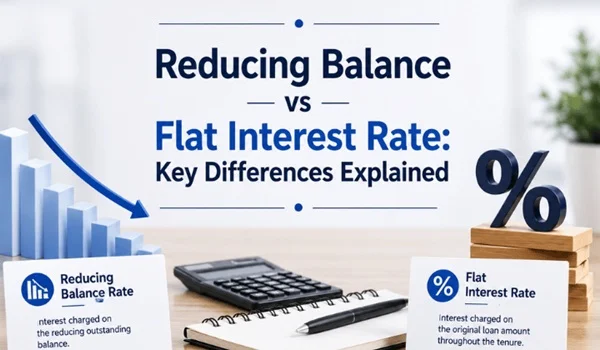
The key difference can be summarized as:
Flat rate → Interest is based on the original loan amount
Reducing balance → Interest is based on the outstanding loan amount
This distinction can make a major difference over the life of a loan.
Why Monthly EMI Can Be Misleading
Borrowers often compare loans based on monthly EMI alone.
But a lower EMI does not necessarily mean a cheaper loan.
A longer loan tenure can reduce the monthly payment while increasing the total interest paid.
Similarly, a loan with a seemingly attractive flat interest rate can have a higher effective borrowing cost than a reducing balance loan with a similar stated rate.
Therefore, borrowers should compare the total repayment amount, not just the EMI.
A Simple Illustration
Imagine two lenders offer the following:
Loan A
- Principal: ₹1,00,000
- Interest: 10% reducing balance
- Tenure: 2 years
Loan B
- Principal: ₹1,00,000
- Interest: 10% flat rate
- Tenure: 2 years
The headline rate is identical.
However, Loan B calculates interest using the original ₹1 lakh throughout the stated period, while Loan A calculates interest based on the declining outstanding balance.
As a result, Loan B can cost more despite showing the same 10% rate.
Flat Rate vs Reducing Balance
| Factor | Flat Interest Rate | Reducing Balance |
| Interest base | Original principal | Outstanding principal |
| Principal decreases | Yes | Yes |
| Interest calculation base | Generally remains original principal | Decreases over time |
| Total interest at same stated rate | Generally higher | Generally lower |
| Rate comparison | Can be misleading without conversion | Usually easier to compare with effective rates |
| Importance of tenure | Very important | Very important |
Why Flat Rates Can Look Attractive
A flat rate can appear inexpensive because the advertised percentage is often lower than the equivalent effective rate.
For example, a lender might advertise a loan at 10% flat, which may sound cheaper than a loan at 18% reducing balance.
But the two rates are not directly comparable.
The borrower needs to determine the effective cost of each loan before deciding.
Flat Rate Is Not the Same as APR
A flat interest rate and an annual percentage rate (APR) are not necessarily the same thing.
APR or similar effective-cost measures can incorporate the timing of payments and, depending on the applicable framework, certain fees and charges.
Therefore, borrowers should look for the lender’s disclosed annualized/effective cost measure, where applicable, rather than comparing headline interest rates alone.
Fees Can Change the Actual Cost
Interest is not always the only cost associated with a loan.
A borrower may also encounter:
- Processing fees
- Documentation charges
- Insurance-related charges
- Prepayment charges, where applicable
- Late payment charges
- Other contractual fees
A loan with a lower interest rate can therefore still have a higher overall cost if it carries substantial additional charges.
Why Loan Tenure Matters
The longer a loan remains outstanding, the more interest can accumulate.
Under a reducing balance structure, extending the tenure generally means interest continues to be charged over a longer period.
Under a flat-rate structure, the calculation can become even more expensive because interest may continue to be based on the original principal for the stated tenure.
This is why borrowers should compare loans using both:
Interest rate + tenure + total repayment
Prepayments Can Affect the Calculation
Prepayment can change the cost of a reducing balance loan because reducing the principal earlier can reduce the amount on which future interest is calculated.
The effect depends on the lender’s terms and whether prepayment is permitted without significant charges.
For flat-rate loans, the benefit of early repayment may work differently because the interest calculation is based on the original principal under the flat-rate structure.
Borrowers should therefore check the loan agreement before assuming that early repayment will produce a particular saving.
Why the Amortisation Schedule Matters
An amortisation schedule shows how each repayment is divided between:
- Principal
- Interest
- Outstanding balance
For a reducing balance loan, the interest component generally declines as the outstanding principal falls, while the principal component increases over time, depending on the repayment structure.
Reviewing the amortisation schedule can help borrowers understand where their money is going.
A Better Way to Compare Loans
Instead of asking only:
“Which lender has the lowest interest rate?”
ask:
- What is the loan amount?
- Is the rate flat or reducing?
- What is the tenure?
- What is the monthly EMI?
- What is the total repayment?
- What are the processing and other charges?
- What is the effective annualized cost?
- Are there prepayment or foreclosure charges?
- What happens if a payment is delayed?
This provides a much clearer picture of the actual cost.
Why the Difference Matters for Borrowers
A borrower who focuses only on the advertised rate may underestimate the cost of a loan.
For example:
10% flat ≠ 10% reducing balance
The percentages look identical, but the calculation method is different.
This is particularly important when comparing personal loans, consumer finance, vehicle loans or other products where lenders may present rates using different methods.
Final Thoughts
A loan’s interest rate cannot be evaluated properly without knowing how that rate is calculated.
With a reducing balance method, interest is calculated on the outstanding principal, which declines as the borrower repays the loan.
With a flat rate, interest is generally calculated using the original principal for the stated tenure.
Therefore, two loans with the same advertised interest rate can have very different total costs.
Before choosing a loan, compare the effective cost, total repayment, EMI, tenure, fees and repayment structure rather than relying only on the headline interest rate.
The most important question is not simply “What is the interest rate?” but “Interest on what amount, calculated in what way, and what will I repay in total?”