Why Insurance Premiums Can Increase With Age
Insurance premiums can change as a person gets older, but the reason depends heavily on the type of insurance involved.
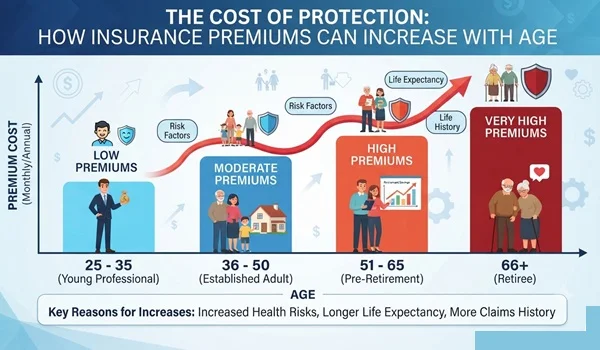
Age is an important pricing factor because the probability, frequency or potential cost of certain insured events can change over time. As insurers estimate higher expected claims for some age groups, premiums may also increase.
However, age is not the only factor that determines an insurance premium. Policy type, coverage amount, health, location, claims history, underwriting rules and other factors can also influence the price.
Why Age Matters to Insurance Companies
Insurance is based on managing uncertain future risks.
When an insurer calculates a premium, it estimates the likelihood and potential cost of claims for a particular group of policyholders.
Age can affect those estimates.
For some types of insurance, certain risks become more likely or more expensive as people get older.
Therefore, age can become an important part of the insurer’s pricing model.
Life Insurance and Age
Age is particularly important in life insurance.
As a person gets older, the statistical probability of death during a given period generally increases.
Because life insurance provides a death benefit, this can increase the insurer’s expected claim cost.
For example, a healthy 25-year-old and a healthy 50-year-old may request the same ₹1 crore life cover.
Even if their current health appears similar, their statistical risk profiles are different.
The insurer may therefore charge different premiums.
Health Insurance and Age
Age can also have a significant impact on health insurance.
As people grow older, the likelihood of requiring medical treatment can generally increase.
Healthcare expenses may also become more significant because of greater healthcare needs.
This can influence health insurance pricing.
However, health insurance pricing can be more complicated because premiums may depend on factors such as:
- Location
- Coverage amount
- Medical history
- Policy features
- Claims experience
- Insurer’s pricing structure
- Age band
The exact effect of age differs between products and insurers.
Age Bands Can Affect Premiums
Some health insurance products use age bands for pricing.
Instead of increasing the premium with every birthday, the premium may remain within a particular age range and change when the policyholder enters a new age band.
For example, an insurer could have different pricing categories for various age groups.
The exact age bands depend on the insurance product.
This means that a customer may sometimes notice a larger premium change at a particular age rather than a small increase every year.
Motor Insurance Is Different
Age can also influence motor insurance, but the relationship is not the same as in life or health insurance.
For motor insurance, insurers may consider factors such as:
- Driver age
- Driving experience
- Vehicle type
- Vehicle age
- Location
- Claims history
- Usage
- Coverage selected
A young or inexperienced driver may be considered higher risk in some pricing models.
For older drivers, other risk factors may become relevant.
Therefore, there is no simple rule that motor insurance always becomes more expensive as someone gets older.
Age Does Not Work Alone
It is important not to assume:
Older person = automatically higher premium
Insurance pricing usually involves multiple factors.
For example, two people of the same age can receive different premiums because they have different:
- Medical histories
- Occupations
- Lifestyle information
- Coverage requirements
- Claims histories
- Locations
- Policy features
The insurer evaluates the overall risk rather than age in isolation.
Why Starting Insurance Earlier Can Matter
For some insurance products, purchasing coverage earlier can result in a lower starting premium.
Consider life insurance.
If someone buys a policy at a younger age and maintains it according to its terms, the initial premium may be lower than if they wait many years before purchasing similar coverage.
There can also be practical advantages to obtaining coverage while health and underwriting circumstances are favorable.
However, the suitability of buying a policy early depends on the person’s financial needs and the type of insurance.
Waiting Can Change the Risk Profile
Someone who delays purchasing insurance may experience changes in circumstances during the waiting period.
For example:
- Age increases
- Health conditions may develop
- Coverage requirements may change
- Income may change
- Family responsibilities may increase
These factors can influence future insurance pricing or underwriting.
This is one reason people often consider securing appropriate coverage before it becomes more expensive or difficult to obtain.
Why Premiums Do Not Always Rise Every Year
Premium changes are determined by the rules of the particular insurance product.
A policy may have:
- Fixed pricing for a defined period
- Age-based pricing
- Annual repricing
- Periodic revisions
- Community-rated pricing
- Other pricing structures
Therefore, customers should check the policy documents rather than assuming that a premium will increase by a particular percentage every year.
Age and Medical Risk Are Different Factors
Age and health are related but should not be treated as identical.
Two people of the same age can have very different health profiles.
Similarly, a person may reach an older age while remaining in excellent health.
An insurer may still use age as a statistical pricing factor even when the individual’s current health appears favorable.
This is because insurance pricing is based on expected risk across groups, not solely on the individual’s current condition.
Why Insurance Companies Use Statistical Data
Insurers rely on large amounts of historical and statistical information to estimate future claims.
For example, they can study how claim frequency and claim costs differ across different age groups.
These patterns allow insurers to develop pricing models.
The goal is not to predict exactly what will happen to one specific policyholder.
Instead, insurers use statistical information to estimate the expected experience of a large group.
Age Can Affect Coverage Affordability
As premiums increase, maintaining the same level of coverage can become more expensive.
This can be particularly important for long-term financial planning.
A person should therefore consider not only whether they can afford the premium today, but also whether the policy remains financially manageable under its applicable pricing structure.
Age-Based Pricing vs Individual Underwriting
These concepts are different.
Age-based pricing means age is incorporated into the general pricing structure.
Individual underwriting involves assessing information about a specific applicant or policyholder.
An insurer may use both depending on the product.
For example, age could determine the basic pricing category while medical or lifestyle information could influence the individual’s final terms.
A Simple Example
Imagine two people applying for the same life insurance coverage.
Person A
- Age: 30
- Coverage: ₹1 crore
Person B
- Age: 50
- Coverage: ₹1 crore
The coverage amount is identical, but the insurer may consider the expected risk over the policy period different because of the age difference.
As a result, the premiums may also differ.
This does not mean that age is the only reason for the difference. Other underwriting factors can also influence the final premium.
Why Higher Premium Does Not Mean the Insurer Is Penalising the Customer
An age-related premium increase is generally a reflection of how the insurer prices expected risk.
Insurance companies need to collect sufficient premiums to support:
- Expected claims
- Operating expenses
- Reserves
- Risk management
- Other costs associated with providing coverage
As the expected risk changes, the pricing structure may change as well.
Final Thoughts
Insurance premiums can increase with age because the probability or expected cost of certain insured events can change as people get older.
This is particularly relevant to life and health insurance, although age can influence other types of insurance in different ways.
However, age is only one part of insurance pricing. Medical history, occupation, location, claims history, coverage amount, policy features and insurer-specific underwriting practices can also affect the final premium.
The important point is that insurance pricing is based on risk rather than age alone. Two people of the same age can still receive different premiums, while the impact of age can vary significantly between different types of insurance.