Crypto Market Cycles: Why Bull and Bear Markets Keep Repeating
The cryptocurrency market is known for large price movements.
Periods of strong optimism can push crypto prices sharply higher, followed by periods of fear, declining demand and significant losses. These recurring phases are commonly described as bull markets and bear markets.
Crypto market cycles do not follow a perfectly predictable timetable. However, several factors can contribute to recurring patterns, including investor psychology, liquidity, leverage, market adoption and changes in expectations.
Understanding these cycles can help explain why cryptocurrency markets can move from extreme optimism to extreme pessimism.
What Is a Crypto Market Cycle?
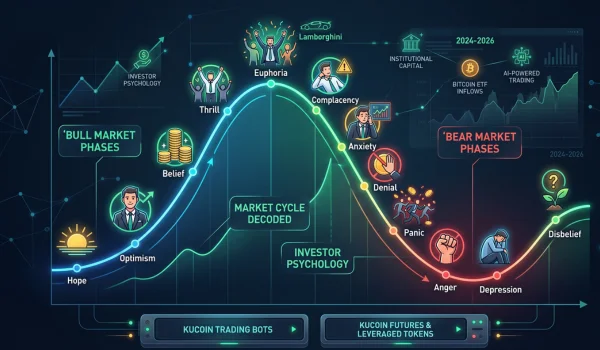
A crypto market cycle is a broad pattern in which market conditions move through periods of:
Accumulation → Expansion → Euphoria → Decline → Capitulation → Recovery
These stages are not official rules, and every cycle can look different.
Some phases may last months, while others can develop much faster.
The important idea is that market prices are influenced not only by fundamentals but also by changing expectations and investor behaviour.
Bull Market
A bull market is a period in which prices generally trend upward and investor confidence is relatively strong.
During a crypto bull market, you may see:
- Rising cryptocurrency prices
- Increasing trading activity
- Growing media attention
- New investors entering the market
- Higher risk-taking
- Strong demand for altcoins
- Increased use of leverage
As prices rise, positive sentiment can attract even more participants.
This can create a self-reinforcing cycle.
Bear Market
A bear market is a prolonged period of declining prices and weaker market sentiment.
During a crypto bear market, investors may experience:
- Falling asset prices
- Lower trading activity
- Reduced speculative demand
- Project failures
- Lower valuations
- Forced liquidations
- Reduced investor confidence
Some investors leave the market entirely, while others begin accumulating assets at lower prices.
Why Do Cycles Repeat?
There is no single reason.
Crypto cycles can emerge from the interaction of several factors.
The major ones include:
- Investor psychology
- Market liquidity
- Leverage
- Supply and demand
- Technological developments
- Regulatory changes
- Capital flows
- Speculation
These factors can reinforce one another.
Investor Psychology Is a Major Driver
Human behaviour plays an important role in financial markets.
When prices rise, investors can become increasingly optimistic.
The cycle can move from:
Optimism → Excitement → Confidence → Greed → Euphoria
When prices begin falling, the emotional process can reverse:
Anxiety → Fear → Panic → Capitulation
This creates an important feature of market cycles:
Investors often become most optimistic after prices have already risen substantially and most pessimistic after prices have already fallen significantly.
The Role of FOMO
FOMO, or fear of missing out, can increase buying during strong markets.
Suppose Bitcoin rises significantly.
People who previously ignored crypto may begin thinking:
“Everyone else is making money. I should buy before prices go even higher.”
More buyers can push prices higher.
Higher prices attract more attention, creating another wave of demand.
This can contribute to speculative excess.
Leverage Can Make Cycles More Extreme
Crypto markets have significant leveraged trading activity.
Leverage allows traders to control a larger position using a smaller amount of capital.
For example, someone with ₹1 lakh may use leverage to create exposure larger than ₹1 lakh.
This can magnify both gains and losses.
When prices fall sharply, leveraged traders may face liquidation.
Forced selling can increase downward pressure.
This can turn an ordinary decline into a much sharper market move.
Liquidity Influences Market Cycles
Liquidity refers broadly to the amount of capital and trading depth available in the market.
When liquidity is abundant, investors may be more willing to purchase risky assets.
This can support:
- Higher crypto valuations
- Greater trading activity
- Increased speculative investment
When liquidity becomes tighter, investors may reduce exposure to riskier assets.
This can place pressure on cryptocurrency prices.
Interest Rates Can Affect Crypto
Crypto is part of the broader financial environment.
Changes in interest rates can influence investor behaviour.
When borrowing costs are relatively low and financial conditions are supportive, investors may be more willing to seek higher-risk assets.
When interest rates rise or financial conditions become tighter, investors may prefer safer or more liquid assets.
This can affect demand for cryptocurrencies.
Bitcoin Often Influences the Broader Market
Bitcoin remains the largest cryptocurrency by market capitalisation and plays an important role in overall crypto-market sentiment.
Strong Bitcoin performance can attract attention toward the broader crypto sector.
Investors may then move into:
- Ethereum
- Large-cap altcoins
- Smaller tokens
- DeFi assets
- Other crypto sectors
This can contribute to broader market expansion.
However, Bitcoin and altcoins do not always move together.
Altcoin Speculation Can Intensify Late-Cycle Behaviour
During strong markets, investors sometimes move further along the risk spectrum.
Capital can move from:
Bitcoin → Large altcoins → Smaller tokens → Highly speculative assets
The later stages of a strong cycle can therefore involve assets with much greater volatility.
These assets may experience extraordinary gains, but they can also experience very large declines when sentiment changes.
The Role of New Narratives
Crypto markets frequently develop new narratives.
Examples can include:
- Decentralised finance
- NFTs
- Layer-2 networks
- Web3
- Metaverse projects
- Artificial intelligence tokens
- Real-world asset tokenisation
A new narrative can attract capital and create strong demand for related assets.
But narratives can lose momentum when expectations become too high or market conditions change.
Bitcoin Halving and Market Cycles
Bitcoin’s supply issuance changes through its halving mechanism.
At predetermined intervals, the number of new bitcoins created through mining rewards is reduced.
Historically, Bitcoin’s halving events have occurred near major changes in the broader market, but this does not mean every halving automatically causes a bull market.
Market cycles involve many factors beyond Bitcoin’s issuance schedule.
Therefore, the halving should be viewed as one factor rather than a guaranteed cycle predictor.
New Supply Can Affect Prices
Crypto markets are also influenced by token supply.
For different projects, supply can increase through:
- Mining
- Staking rewards
- Token emissions
- Token unlocks
- Treasury distributions
If supply grows faster than demand, prices can face pressure.
If demand grows faster than available supply, prices may experience upward pressure.
This supply-demand relationship is one of the basic economic forces behind crypto markets.
The Transition From Bull Market to Bear Market
A bull market does not necessarily end because one specific event occurs.
Instead, several factors may change at the same time.
For example:
- Valuations become stretched
- New buyers become less willing to pay higher prices
- Leverage increases
- Liquidity conditions weaken
- Negative news changes sentiment
- Large holders begin selling
- Demand slows
Once upward momentum weakens, highly leveraged positions can amplify the decline.
Why Bear Markets Can Become Severe
Crypto assets are generally volatile and often have substantial speculative participation.
When prices start falling, several things can happen simultaneously:
Price declines → Leveraged positions liquidate → Forced selling increases → Sentiment worsens → More investors sell
This feedback loop can accelerate the decline.
Capitulation
Capitulation refers to a period when investors sell aggressively because they no longer expect prices to recover soon.
It can occur after a prolonged decline.
During capitulation:
- Fear can become extreme
- Trading volumes may surge
- Prices can fall rapidly
- Highly leveraged positions may disappear
- Weak projects may fail
Capitulation does not guarantee that the market has reached its final bottom.
Why Bear Markets Can Be Useful for the Market
Bear markets can remove some of the excess created during speculative periods.
Projects with weak business models may struggle to survive.
Investors may become more selective.
Capital can shift toward projects with stronger:
- Technology
- User adoption
- Developer activity
- Financial resources
- Long-term utility
This process can contribute to the development of the next market cycle.
Accumulation and Recovery
After a prolonged decline, some investors may begin purchasing assets at lower valuations.
This can create an accumulation phase.
During this stage:
- Prices may move sideways
- Volatility may decline
- Investor interest may remain low
- Stronger projects may continue developing
Eventually, improving liquidity, adoption or market sentiment can help trigger another expansion phase.
Why Cycles Are Not Exact
One common mistake is assuming that crypto cycles operate according to a fixed calendar.
For example:
“Every four years, Bitcoin must reach a new high.”
Historical patterns cannot guarantee future outcomes.
Market conditions change.
The crypto market today has:
- Different participants
- Different regulations
- Different financial products
- Different institutional involvement
- Different levels of adoption
Therefore, previous cycles should be studied as historical patterns rather than guaranteed schedules.
Crypto Cycles Can Overlap
Different parts of the crypto market can be in different phases at the same time.
For example:
Bitcoin could be recovering while a particular altcoin remains in a long-term decline.
Similarly, a new crypto sector could be experiencing rapid growth while older projects lose attention.
This means there is not always one single cycle covering every cryptocurrency.
What Market Cycles Reveal About Risk
Crypto market cycles demonstrate why past returns can be misleading.
A token that gained 500% during a bull market may subsequently lose a substantial portion of that gain.
Strong historical performance does not guarantee similar future returns.
Investors should therefore consider:
- Volatility
- Liquidity
- Valuation
- Token supply
- Leverage
- Project fundamentals
- Personal risk tolerance
Final Thoughts
Crypto market cycles repeat because markets are influenced by recurring combinations of human psychology, liquidity, speculation, leverage, supply and demand.
During strong markets, rising prices can create optimism and attract additional capital.
During declining markets, falling prices can trigger fear, liquidations and further selling.
However, these cycles do not follow a perfectly predictable schedule.
The most important lesson is:
Crypto market cycles are patterns of changing market conditions—not guaranteed timelines.
Understanding how optimism, leverage, liquidity, supply, demand and investor behaviour interact provides a more useful framework than trying to predict the exact date of the next crypto bull or bear market.