Mens Rea vs Actus Reus: The Two Elements Behind Many Criminal Offences
Criminal law generally does not treat every harmful act as a crime. In many offences, prosecutors must establish both what the accused did and the required state of mind behind that conduct.
Two traditional legal terms are used to describe these concepts:
- Actus reus – the prohibited act or conduct
- Mens rea – the required mental element
Together, they help explain why criminal liability often depends not only on what happened, but also on the circumstances and mental state surrounding the conduct.
However, these principles are not absolute. Some offences have specific statutory requirements, and certain offences may impose liability without requiring the same level of subjective intent.
What Is Actus Reus?
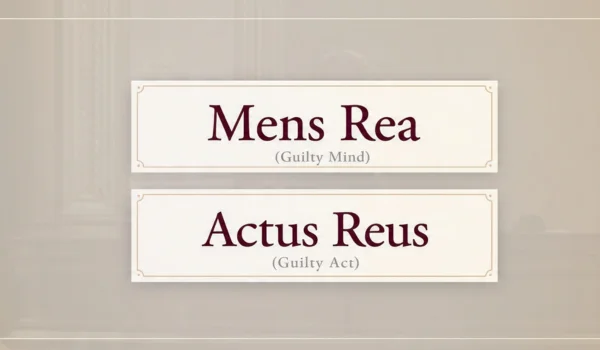
Actus reus is traditionally used to describe the physical element or prohibited conduct of a criminal offence.
It can involve more than simply a physical movement.
Depending on the offence, the relevant conduct may include:
- A positive act
- A failure to act where there is a legal duty
- A particular circumstance
- A prohibited result
- Possession of something prohibited
The exact actus reus depends on the definition of the specific offence.
What Is Mens Rea?
Mens rea refers broadly to the mental element required for a criminal offence.
Depending on the offence, the required mental state may involve concepts such as:
- Intention
- Knowledge
- Recklessness
- Awareness
- A particular state of mind specified by statute
The required mental element differs from offence to offence.
Therefore, it is not correct to assume that every crime requires proof of the same type of intention.
The Basic Difference
A simple way to remember the concepts is:
Actus reus = What legally prohibited conduct occurred?
Mens rea = What was the required mental state when that conduct occurred?
A prosecutor may need to establish both, depending on the offence and applicable law.
A Simple Example
Imagine a person accidentally picks up someone else’s identical umbrella at a restaurant, genuinely believing it belongs to them.
The physical act of taking the umbrella may be obvious.
But if the relevant offence requires a particular dishonest intention, the person’s genuine belief could become important.
The physical conduct alone may not establish every required element of the offence.
The exact legal outcome would depend on the applicable law and facts.
Why Mens Rea Matters
Criminal law often distinguishes between:
Accidental conduct
and
Intentional or otherwise blameworthy conduct.
Suppose a driver accidentally hits another vehicle despite taking reasonable care.
The physical event occurred.
But whether the driver committed a particular criminal offence depends on the elements of that offence.
A criminal offence may require negligence, recklessness, knowledge, intention or another specified mental element.
Intention Is Not the Same as Motive
This distinction is important.
Intention concerns what a person meant or intended to do.
Motive concerns the reason why the person acted.
For example, a person may intentionally steal money because they want to pay a debt.
The desire to pay the debt is the motive.
The intention to take the money without lawful entitlement may be part of the required mental element of the offence.
Motive can sometimes be relevant evidence, but it is not automatically an element of every crime.
Knowledge
Some offences require proof that the accused knew a particular fact.
For example, an offence may require knowledge that an item was stolen.
If a person genuinely had no knowledge of the relevant fact, that may be important to the required mental element, depending on the offence.
The prosecution must establish whatever mental state the law requires.
Recklessness
Some criminal offences can involve recklessness rather than a specific intention to cause a result.
Broadly speaking, recklessness can involve consciously taking an unjustifiable risk, although the precise legal definition depends on the jurisdiction and offence.
For example, a person may not specifically intend to cause a particular harm but may knowingly engage in conduct involving a serious and unjustifiable risk.
Whether that satisfies mens rea depends on the applicable law.
Criminal Negligence
Some offences may be based on a form of criminal negligence or another objectively defined fault standard.
This is one reason the statement:
“Every crime requires intent.”
is too broad.
The prosecution must prove the mental or fault element specified by the particular offence.
Omissions Can Also Matter
Actus reus does not necessarily mean that the accused must have performed a physical action.
In some circumstances, a failure to act can satisfy the physical element where the person had a legally recognised duty to act.
For example, certain laws may impose specific duties on particular people in particular circumstances.
Simply failing to help another person is not automatically a criminal offence.
There generally needs to be a legal basis for imposing a duty to act.
Possession Can Be an Actus Reus
Some offences concern possession of prohibited items.
In such cases, the relevant conduct may involve possession rather than a traditional physical act.
The law may also require a particular mental element, such as knowledge or awareness of the item’s nature.
Again, the precise requirements depend on the statute.
Result-Based Offences
Some crimes require a particular result.
For example, an offence may require proof that a person caused a particular type of injury or damage.
The prosecution may therefore need to establish:
- The prohibited conduct
- The required connection between the conduct and result
- The required mental state
This is why criminal cases can involve detailed questions about causation.
Causation
Where an offence requires a particular result, the prosecution may need to establish that the accused’s conduct legally caused that result.
Suppose a person is accused of causing an injury.
It may not be enough to prove that they performed a particular act.
The prosecution may also need to establish the required causal connection between that conduct and the injury.
The exact causation rules vary depending on the offence and jurisdiction.
Actus Reus and Mens Rea Must Relate to the Same Offence
The concepts are not simply two independent boxes that can be filled separately.
The required mental state generally must relate to the relevant conduct or circumstances specified by the offence.
For example, a person may intentionally perform an act without knowing a particular circumstance that the offence requires them to know.
Whether criminal liability exists depends on the precise statutory elements.
Strict Liability Offences
Some offences do not require proof of mens rea for every element.
These may sometimes be described as strict liability offences, depending on the legal system.
In such cases, the prosecution may not have to prove the same mental state that would be required for an ordinary intent-based offence.
However, strict liability does not mean that no elements need to be proved.
The prosecution still has to establish the elements that the relevant law requires.
Presumption of Innocence
The distinction between actus reus and mens rea also connects with the broader principle of the presumption of innocence in criminal proceedings.
Generally, the prosecution bears the burden of proving the required elements of the offence.
The accused does not ordinarily have to prove their innocence simply because they have been charged.
Specific rules concerning burdens and defences can vary by jurisdiction.
How Prosecutors Establish Mens Rea
Mental state cannot usually be observed directly.
Prosecutors may therefore rely on surrounding evidence, such as:
- Statements made by the accused
- Actions before the incident
- Actions during the incident
- Actions afterward
- Digital communications
- Financial records
- Witness testimony
- Circumstances of the conduct
The court can use this evidence to determine whether the required mental state has been established.
Direct and Circumstantial Evidence
Mens rea can be established through either direct or circumstantial evidence, depending on the legal rules.
For example, a person’s written message explicitly stating an intention may be direct evidence of their state of mind.
Alternatively, the court may infer intention from the person’s conduct and surrounding circumstances.
Defences Can Affect Mens Rea
Certain legal defences may challenge whether the required mental element existed or whether the accused should be held criminally responsible.
Depending on the jurisdiction and offence, issues may include:
- Mistake of fact
- Lack of knowledge
- Duress
- Insanity or mental incapacity under applicable legal standards
- Self-defence
- Other statutory or common-law defences
The legal requirements for each defence are specific.
Actus Reus vs Mens Rea
| Feature | Actus Reus | Mens Rea |
| Basic meaning | Physical/prohibited element | Mental element |
| Main question | What conduct or result occurred? | What was the required mental state? |
| Can involve | Act, omission, possession, circumstances or result | Intention, knowledge, recklessness or another specified fault element |
| Usually relevant to | Elements of the offence | Elements of the offence |
| Proved through | Physical and documentary evidence, testimony and circumstances | Statements, conduct, circumstances and other evidence |
Why Both Concepts Matter
Imagine two people are involved in the same type of accident.
One person deliberately drives into another vehicle.
The other loses control because of an unexpected mechanical failure despite taking reasonable precautions.
The physical outcome may be similar.
But their criminal liability may be completely different because the required elements and mental state may differ.
This demonstrates why criminal law does not always focus solely on the result.
Not Every Harmful Act Is a Crime
A person can cause harm without committing a criminal offence.
For example, an accidental event may result in civil liability, insurance consequences or other legal issues without satisfying the elements of a criminal offence.
Criminal liability requires the prosecution to establish the elements of the particular offence.
Modern Criminal Statutes
Although actus reus and mens rea are traditional legal terms, modern criminal statutes often define offences using much more specific language.
A statute may expressly state requirements involving:
- Intention
- Knowledge
- Awareness
- Dishonesty
- Recklessness
- Negligence
- Specific conduct
- Specific circumstances
Therefore, courts generally examine the actual wording of the relevant offence rather than relying only on the traditional labels.
Final Thoughts
Actus reus and mens rea are two fundamental concepts used to understand criminal liability.
Actus reus generally concerns the prohibited conduct, circumstances or result involved in an offence.
Mens rea generally concerns the mental or fault element required by that offence.
The two concepts help explain why simply proving that something happened is often not enough to establish criminal guilt.
However, the exact requirements differ between offences and jurisdictions. Some offences may require intention, while others may be based on knowledge, recklessness, negligence or another legally defined standard.
The key takeaway is:
Criminal liability often depends not only on what a person did, but also on the legally required state of mind associated with that conduct.