Legal Notice vs Demand Letter: How Their Legal Significance Differs
Legal disputes often begin with a written communication asking another person or business to take a specific action.
Two terms commonly used for such communications are legal notice and demand letter.
They may appear similar because both can be used before formal legal proceedings. However, their purpose, wording, legal significance and use can differ depending on the jurisdiction and circumstances.
A demand letter is generally focused on asking for a specific remedy, such as payment or performance. A legal notice can be broader and may formally communicate a legal grievance, demand, intention to take legal action or compliance requirement.
The terms are also not used identically in every legal system.
What Is a Legal Notice?
A legal notice is a formal written communication informing a person or organisation about a legal grievance, claim, demand or proposed legal action.
It may be sent by:
- An individual
- A lawyer on behalf of a client
- A company
- An organisation
- Another legally interested party
The notice may explain what the sender believes has happened, identify the legal or contractual issue and state what the recipient is expected to do.
Depending on the situation, it may also warn that legal proceedings could follow if the issue is not resolved.
What Is a Demand Letter?
A demand letter is generally a written request requiring the recipient to take a particular action.
Common demands include:
- Paying money
- Returning property
- Performing a contractual obligation
- Stopping certain conduct
- Correcting an alleged breach
- Providing documents or information
For example, a business may send a demand letter requesting payment of an overdue invoice before considering further legal action.
The Main Difference
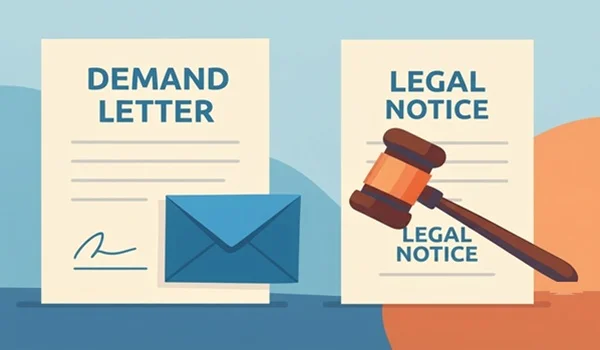
The simplest distinction is:
Demand letter → Focuses primarily on what the recipient is being asked to do.
Legal notice → Communicates a legal grievance, position, demand or potential legal consequence in a more formal legal context.
However, the distinction is not absolute.
A document can function as both a legal notice and a demand letter depending on its contents and the applicable law.
Legal Notice vs Demand Letter
| Feature | Legal Notice | Demand Letter |
| Main purpose | Communicate a legal grievance, claim or intended action | Demand a specific remedy or action |
| Typical content | Facts, legal position, demand and possible consequences | Facts, amount/action demanded and deadline |
| Formality | Often more formal | Can range from informal to highly formal |
| Sent by | Individual, company or lawyer | Individual, company or lawyer |
| Court document? | Usually not | Usually not |
| Creates a court case automatically? | No | No |
| May precede litigation? | Yes | Yes |
| Can include a payment demand? | Yes | Yes |
Neither Is Automatically a Court Order
This is an important distinction.
A legal notice or demand letter is generally not the same as a court order.
A court order is issued by a court or other authorised judicial body.
A private party or lawyer cannot normally create a court order simply by sending a letter.
Therefore:
Legal notice ≠ Court order
Demand letter ≠ Court order
Receiving either document does not mean that a court has already ruled against you.
Neither Automatically Starts a Lawsuit
Sending a legal notice or demand letter does not, by itself, generally create a lawsuit.
A lawsuit or other formal proceeding normally requires the appropriate filing or procedural step under the applicable legal system.
However, some laws or procedures may require a particular notice before certain proceedings can be initiated.
That is why the specific type of dispute matters.
Some Notices Are Legally Required
One important qualification is that certain legal claims or proceedings may involve mandatory notice requirements.
For example, particular statutes or procedural rules may require notice to be given to a specific party before legal action can proceed.
In such situations, the notice is not merely a general demand for payment or compliance.
Its timing, contents and method of service can have procedural significance.
Therefore, it is important not to assume that every document called a “legal notice” has the same legal effect.
A Demand Letter May Be Entirely Voluntary
A demand letter can simply be a practical attempt to resolve a dispute before litigation.
For example:
A customer claims that a contractor failed to complete agreed work and requests repayment of ₹50,000 within a specified period.
The sender may give the contractor an opportunity to resolve the matter before filing a claim.
There may be no requirement to send such a letter unless a contract, law or applicable procedure says otherwise.
Why Send a Legal Notice?
A legal notice can serve several purposes.
It may:
- Clearly communicate the dispute
- Put the recipient on notice of a claim
- State the sender’s position
- Request a specific remedy
- Create a written record
- Provide an opportunity to resolve the dispute
- Satisfy a statutory or contractual notice requirement where applicable
It can therefore be both a communication tool and, in some situations, a procedural step.
Why Send a Demand Letter?
A demand letter is often used to attempt resolution without immediately going to court.
For example, a creditor may demand payment of an outstanding amount.
A demand letter can:
- Identify the amount claimed
- Explain why the money is allegedly owed
- Set a payment deadline
- State what may happen if payment is not made
This can give the recipient an opportunity to resolve the matter before litigation becomes necessary.
A Demand Letter Can Be Strong Without Being Aggressive
A well-written demand letter generally focuses on facts rather than threats.
It may state:
- What happened
- What obligation exists
- What amount or action is being demanded
- The deadline
- The proposed next step if the issue remains unresolved
Using exaggerated or abusive language can make a dispute more difficult to resolve.
What Does Receiving One Mean?
Receiving a legal notice or demand letter generally means that another party is asserting a claim or requesting action.
It does not automatically mean that the sender is legally correct.
The recipient should examine:
- Who sent it
- What is being alleged
- What evidence is referenced
- Whether a contract is involved
- Whether a deadline is specified
- Whether a legal or statutory provision is mentioned
- Whether the claim appears valid
- Whether a formal proceeding has already been filed
Ignoring a Legal Notice Can Be Risky
Although a private legal notice is not itself a court judgment, ignoring it may not be a good strategy.
Depending on the circumstances, failing to respond could:
- Miss an opportunity to settle
- Allow a dispute to escalate
- Result in missed contractual or procedural deadlines
- Make it harder to organise a defence later
The consequences depend on the type of dispute and the applicable law.
Ignoring a Demand Letter
The consequences of ignoring a demand letter also depend on the situation.
For example, if a business receives a demand for payment supported by a valid contract, ignoring it could lead to:
- Further collection efforts
- Arbitration
- Litigation
- Additional costs or interest where legally applicable
But receiving a demand letter does not automatically establish that the demanded amount is legally owed.
The Importance of Deadlines
Both types of documents may contain a deadline.
For example:
“Please make payment within 15 days.”
A deadline can be important, but its legal significance depends on the circumstances.
A deadline written by the sender does not automatically create a legally binding period unless supported by the relevant contract, statute, court rule or other applicable authority.
Can a Legal Notice Be Used as Evidence?
A legal notice can become part of the documentary record of a dispute.
For example, it may help establish:
- What the sender claimed
- When the recipient was informed
- What remedy was requested
- Whether an opportunity to resolve the matter was provided
Whether and how a particular notice is admissible or useful as evidence depends on the applicable rules of evidence and procedure.
Can a Demand Letter Be Used as Evidence?
Similarly, a demand letter may become part of the documentary record.
The letter itself does not prove that every statement in it is true.
It can, however, demonstrate that a particular demand was made and communicated.
The underlying evidence supporting the claim remains important.
Legal Notice and Demand Letter Can Overlap
The distinction is not always clear-cut.
A lawyer might send a document titled:
“Legal Notice and Demand for Payment”
Such a document could both:
- Formally notify the recipient of an alleged legal violation, and
- Demand payment or another remedy.
The contents and legal context matter more than the title alone.
What Should a Good Demand Letter Contain?
Depending on the situation, it may include:
- Sender’s details
- Recipient’s details
- Relevant background facts
- Contract or transaction details
- Nature of the alleged breach
- Amount or remedy demanded
- Supporting documents
- Deadline for response or compliance
- Proposed resolution
- Possible next steps
The exact requirements vary depending on the jurisdiction and dispute.
What Should a Legal Notice Contain?
A legal notice may contain:
- Details of the parties
- Relevant facts
- Description of the dispute
- Legal basis of the claim
- Specific demand
- Applicable deadline
- Consequences of non-compliance
- Details of the sender or authorised representative
Where a particular law requires a specific form or content, those requirements should be followed.
The Importance of Jurisdiction
The terminology and legal significance of these documents vary considerably between countries and even between different types of proceedings within the same country.
A document commonly called a “legal notice” in India may not have exactly the same procedural meaning as a document described as a “legal notice” elsewhere.
Similarly, “demand letter” is a broad term whose legal significance depends heavily on the underlying claim.
Therefore, the applicable jurisdiction should always be considered.
Final Thoughts
Legal notices and demand letters are both commonly used to communicate disputes before formal legal proceedings, but they are not necessarily interchangeable.
A demand letter generally focuses on obtaining a specific action, such as payment, performance or cessation of conduct.
A legal notice can be broader and may formally communicate a legal grievance, demand or intention to pursue a legal remedy. In certain circumstances, a particular type of notice may also be required by law before proceeding.
Most importantly, neither document should automatically be confused with a court summons, court order or judgment.
The title of the document is also not everything. Its contents, purpose, legal basis, applicable law and procedural context determine its actual significance.