Token Supply vs Token Demand: What Actually Drives Crypto Valuation?
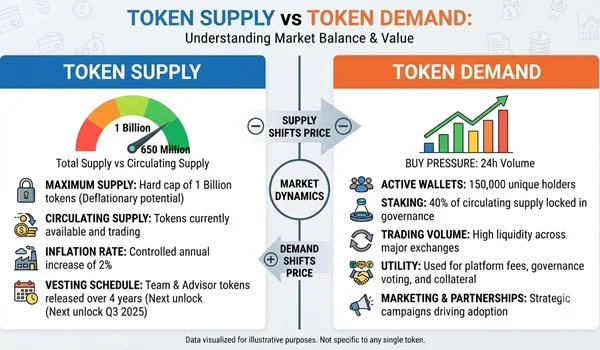
The value of a cryptocurrency token is often discussed in terms of its supply.
People may point to a limited maximum supply and assume that scarcity alone should make a token valuable.
But supply is only one side of the equation.
For a token to maintain or increase its market value, there generally needs to be sufficient demand from buyers who want to hold, use, trade or otherwise obtain the asset.
This is why understanding the relationship between token supply and token demand is more useful than looking at supply alone.
What Is Token Supply?
Token supply refers to the number of tokens that exist or are expected to exist under a project’s token economics.
Depending on the cryptocurrency, you may encounter several different supply measures:
- Circulating supply
- Total supply
- Maximum supply
These figures are not interchangeable.
Circulating Supply
This refers broadly to tokens currently considered available in the market.
Total Supply
This generally refers to the number of tokens that have been created, excluding certain tokens that may have been permanently removed, depending on the methodology used.
Maximum Supply
This is the maximum number of tokens that the protocol or project intends to create, where a maximum exists.
Some tokens do not have a fixed maximum supply.
Why Supply Alone Does Not Determine Value
Imagine two tokens:
Token A: 1 million tokens
Token B: 1 billion tokens
It would be incorrect to conclude that Token A must be more valuable simply because it has fewer tokens.
The price of each token depends on the interaction between its supply and demand.
A token with a large supply can have a high total market value if demand is strong.
A token with a tiny supply can remain almost worthless if very few people want it.
The Basic Supply-Demand Relationship
A simplified way to think about crypto valuation is:
Strong demand + limited or controlled supply → Potential upward price pressure
Weak demand + increasing supply → Potential downward price pressure
But this is not a guaranteed formula.
Crypto markets are influenced by liquidity, expectations, speculation, market structure and many other factors.
Market Capitalisation Matters
One of the most important numbers for comparing tokens is market capitalisation.
A simplified formula is:
Market Capitalisation = Token Price × Circulating Supply
For example:
Suppose a token trades at ₹10 and has 10 million circulating tokens.
Its approximate market capitalisation would be:
₹10 × 10 million = ₹100 million
If another token trades at ₹1 but has 1 billion circulating tokens:
₹1 × 1 billion = ₹1 billion
The second token has a lower individual price but a much higher market capitalisation.
This demonstrates why token price alone can be misleading.
Why a Low Token Price Does Not Mean a Token Is Cheap
Suppose Token A costs ₹0.50.
That may look extremely cheap compared with another cryptocurrency priced at ₹50,000.
But if Token A has a huge circulating supply, its total valuation could already be substantial.
Investors should therefore consider:
Price + circulating supply + market capitalisation
rather than price alone.
Demand Is More Than Speculation
Demand for a token can come from different sources.
For example:
- Use of the blockchain
- Payment utility
- DeFi applications
- Governance
- Staking
- Network fees
- Access to services
- Investment demand
- Speculation
The strength and sustainability of these demand sources can vary considerably between projects.
Utility Can Create Demand
A token may have a specific function within its ecosystem.
For example, it could be required to:
- Pay network fees
- Participate in governance
- Access particular applications
- Secure a network through staking
- Use specific services
If users genuinely need the token to access valuable activity, this can create a source of demand.
However, having a stated utility does not automatically mean that demand will be large or sustainable.
Speculative Demand Is Different
Some crypto demand comes primarily from expectations of future price increases.
A buyer may purchase a token because they believe someone else will pay more for it later.
This can create substantial short-term demand.
However, speculative demand can also reverse quickly when market sentiment changes.
This is why a token’s price can sometimes rise dramatically without a comparable increase in fundamental usage.
Token Unlocks Can Increase Supply
A project may initially distribute only part of its total token allocation.
The remaining tokens could be scheduled for release over time.
These are often referred to as token unlocks.
For example:
Circulating supply: 300 million tokens
Future scheduled unlocks: 200 million tokens
If those additional tokens enter circulation, the available supply can increase substantially.
If demand does not increase at a similar pace, the additional supply can create selling pressure.
Supply Inflation Can Affect Valuation
Some tokens continuously issue new units.
Suppose:
- Existing supply: 100 million tokens
- New annual issuance: 10 million tokens
The supply increases by approximately 10% before considering other changes.
If demand remains unchanged, the additional supply can create downward pressure on the token price.
This is one reason investors sometimes examine a token’s emission schedule.
Burning Tokens Is the Opposite Mechanism
Some projects remove tokens from circulation through token-burning mechanisms.
If tokens are permanently removed, the circulating or total supply can decrease depending on the specific design.
However, a token burn does not automatically make the token more valuable.
For a burn to have meaningful economic impact, demand and the size and sustainability of the reduction also matter.
Fully Diluted Valuation
Another useful concept is Fully Diluted Valuation (FDV).
A simplified formula is:
FDV = Current Token Price × Maximum or Fully Diluted Token Supply
For example:
Token price: ₹5
Maximum supply: 1 billion
FDV: ₹5 billion
Now suppose only 200 million tokens are currently circulating.
The circulating market capitalisation would be:
₹5 × 200 million = ₹1 billion
The difference between the current market capitalisation and FDV can be important because future token issuance may increase the supply available to the market.
High FDV With Low Circulating Supply
A token with a relatively small circulating supply but a very large fully diluted supply can create a potential supply-overhang issue.
For example:
- Circulating supply: 10%
- Future supply: 90%
As additional tokens become available, the market may need significantly more demand to absorb them without downward pressure.
This does not guarantee that the price will fall, but it is an important factor to examine.
Token Demand Can Change Quickly
Demand for cryptocurrencies can be highly dynamic.
A token may experience strong demand because of:
- New users
- Growing application activity
- Exchange listings
- New ecosystem developments
- Market speculation
But demand can also decline because of:
- Falling user activity
- Competition
- Negative sentiment
- Regulatory developments
- Security incidents
- Changes in market conditions
This makes crypto valuation particularly difficult to predict.
Network Activity Can Provide Clues
For tokens tied closely to blockchain ecosystems, network activity can provide useful context.
Depending on the blockchain, investors may examine:
- Transaction activity
- Active addresses
- Fees generated
- Total value locked
- Developer activity
- Application usage
These metrics do not directly determine token price, but they can help assess whether there is real activity supporting the ecosystem.
Demand and Token Value Are Not Always Directly Connected
A blockchain can experience significant activity without its native token necessarily capturing all of the economic value created by that activity.
This depends on the token’s design.
For example, investors may ask:
Does increased network usage actually require more of the token?
If users can use the network without needing to hold substantial amounts of its token, network growth may not translate proportionally into token demand.
This is an important distinction between network success and token value capture.
Liquidity Also Matters
Two tokens can have similar market capitalisations but very different liquidity.
A highly liquid token may have substantial trading activity and deep markets.
A less liquid token may experience large price movements from relatively small buy or sell orders.
Therefore, market capitalisation alone does not provide a complete picture of a token’s market dynamics.
Why Tokenomics Matter
Tokenomics refers broadly to the economic design of a cryptocurrency token.
Important factors can include:
- Initial supply
- Maximum supply
- Issuance rate
- Token distribution
- Vesting schedules
- Unlocks
- Burning mechanisms
- Staking incentives
- Utility
- Governance structure
Understanding these factors can help investors identify how supply may change over time.
A Simple Example of Supply and Demand
Imagine a token has:
100 million circulating tokens
and strong demand from users and investors.
Now suppose the project releases another 50 million tokens.
The supply has increased by 50%.
For the price to remain at the same level, the market may need enough additional demand to absorb the new supply.
If demand grows faster than supply, the price may experience upward pressure.
If supply grows faster than demand, the opposite may occur.
This is a simplified model, but it illustrates the basic economic relationship.
Why Scarcity Can Be Misleading
A token may advertise a maximum supply of only 10 million units.
That sounds scarce.
But scarcity has economic value only when people actually want the scarce asset.
A rare object that nobody wants can have little value.
The same basic principle applies to crypto:
Scarcity can support value, but scarcity alone does not create demand.
What Actually Drives Crypto Valuation?
There is no single factor that determines cryptocurrency valuation.
Important factors can include:
- Supply and issuance
- User demand
- Utility
- Network adoption
- Market liquidity
- Investor expectations
- Competition
- Token distribution
- Future unlocks
- Macro-economic conditions
- Market sentiment
The relative importance of these factors can vary from one token to another.
Final Thoughts
Token valuation is not simply a question of how many tokens exist.
The more important question is how available supply interacts with actual and expected demand.
A token with limited supply can lose value if demand disappears. A token with a large supply can achieve a substantial valuation if demand is strong enough.
Investors should therefore look beyond the token’s headline price and examine:
Circulating supply + future supply + demand + utility + market capitalisation + token distribution
The simplest way to remember the concept is:
Supply determines how many tokens are available. Demand determines how strongly the market wants them. Their interaction helps shape the token’s market price.