Arbitration vs Litigation: How Dispute Resolution Changes the Process
When a business or individual becomes involved in a legal dispute, going to court is not always the only option.
Depending on the circumstances, the dispute may be resolved through litigation or arbitration.
Both processes can involve legal arguments, evidence, lawyers and a final decision. However, the way the dispute is handled can be very different.
Litigation takes place through the court system, while arbitration involves a private dispute-resolution process in which an arbitrator or arbitral tribunal decides the dispute.
The choice between them can affect the procedure, decision-maker, privacy, costs, timeline and options for challenging the final decision.
What Is Litigation?
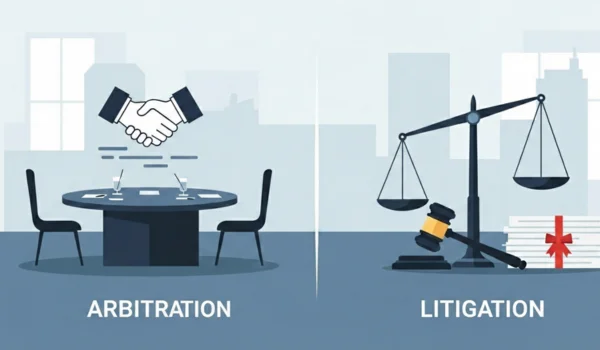
Litigation is the process of resolving a dispute through the courts.
A typical civil lawsuit may involve:
- Filing a claim or complaint
- Service of the legal documents
- Response from the opposing party
- Exchange of information and evidence
- Motions or interim applications
- Hearings
- Trial, where required
- Judgment
- Appeal or enforcement proceedings, where applicable
The exact process differs between jurisdictions and types of cases.
What Is Arbitration?
Arbitration is a private dispute-resolution process in which an arbitrator or arbitral tribunal is appointed to decide a dispute.
Arbitration is generally based on an arbitration agreement between the parties, although particular legal frameworks can create specific exceptions or mechanisms.
The arbitration agreement may appear in a contract before any dispute occurs.
For example:
“Any dispute arising out of this agreement shall be referred to arbitration.”
If the agreement is valid and applicable, the parties may be required to resolve covered disputes through arbitration rather than ordinary court litigation, subject to applicable law.
The Main Difference
The basic distinction is:
Litigation → The dispute is decided through the court system.
Arbitration → The dispute is decided by an arbitrator or arbitral tribunal under an agreed or legally applicable arbitration framework.
Both can result in a legally enforceable decision.
Who Decides the Dispute?
In litigation, the decision-maker is a judge or, in some systems, a judge and jury depending on the type of case.
In arbitration, the dispute is decided by an arbitrator or arbitral tribunal.
The parties may have greater involvement in selecting the arbitrator, depending on the arbitration agreement and applicable institutional or procedural rules.
Arbitration Usually Requires an Agreement
A major feature of arbitration is the role of consent.
Businesses often include arbitration clauses in contracts before a dispute occurs.
For example:
“Any dispute arising from this agreement shall be finally resolved by arbitration.”
The validity, scope and enforceability of such a clause depend on the applicable law.
Without a valid basis for arbitration, a party generally cannot simply force another party into arbitration merely because it prefers that process.
Litigation Does Not Usually Require Prior Agreement
If a person has a legally recognised claim, they can generally bring it before a competent court according to the applicable procedural rules.
The defendant’s prior agreement to litigation is normally not required.
This is one reason courts remain central to dispute resolution.
Arbitration Can Be More Flexible
Arbitration procedures can sometimes be tailored to the dispute.
The parties may be able to agree on matters such as:
- Number of arbitrators
- Appointment procedure
- Place or seat of arbitration
- Applicable procedural rules
- Language
- Hearing arrangements
- Institutional or ad hoc arbitration
However, flexibility does not mean that arbitration has no rules.
The arbitration agreement, applicable arbitration law and chosen procedural rules still matter.
Court Procedures Are More Structured
Court litigation generally follows formal procedural rules established by legislation, court rules and judicial practice.
These rules can govern:
- Filing documents
- Deadlines
- Evidence
- Hearings
- Discovery or disclosure
- Motions
- Appeals
- Judgments
This structure provides consistency but can sometimes make litigation more procedurally complex.
Arbitration Can Be Private
Arbitration proceedings are generally conducted privately between the parties and the tribunal.
However, private does not always mean absolutely confidential.
Confidentiality can depend on:
- The arbitration agreement
- Institutional rules
- Applicable law
- Procedural orders
- The circumstances of the dispute
Therefore, parties should not assume that every piece of information connected with arbitration is automatically protected from disclosure.
Court Proceedings Can Be Public
Court proceedings are often subject to principles of public access and open justice.
Court filings, hearings and judgments may be publicly accessible, subject to applicable laws and exceptions.
Certain sensitive matters can receive special protection, but the exact rules vary by jurisdiction.
Arbitration and Expertise
One potential advantage of arbitration is the ability to select an arbitrator with relevant expertise.
For example, a complex construction dispute may involve technical issues concerning:
- Engineering
- Project management
- Contract administration
- Construction standards
Depending on the arbitration arrangement, the parties may choose an arbitrator with relevant experience.
Court judges, by contrast, are general judicial decision-makers rather than specialists selected by the parties for each commercial dispute.
Litigation Also Has Specialist Courts
The distinction should not be overstated.
Some court systems have specialised courts or tribunals dealing with particular categories of disputes.
Therefore, arbitration is not the only mechanism through which technical or specialised disputes can be handled.
Cost Can Differ
Neither arbitration nor litigation is automatically cheaper.
Arbitration may involve:
- Arbitrator fees
- Institutional fees
- Lawyers’ fees
- Expert fees
- Venue and hearing costs
Court litigation can involve:
- Court fees
- Lawyers’ fees
- Expert costs
- Administrative expenses
- Appeal costs
The total cost depends heavily on the complexity, duration and value of the dispute.
Arbitration Is Not Always Faster
Arbitration is sometimes described as a faster alternative to litigation.
It can be faster in some circumstances, particularly where procedures are streamlined.
However, complex arbitration can also take considerable time.
Multiple arbitrators, extensive evidence, expert witnesses, jurisdictional objections and procedural applications can make an arbitration lengthy.
Therefore:
Arbitration ≠ automatically fast
and
Litigation ≠ automatically slow
Evidence in Arbitration
Arbitration can involve many of the same types of evidence used in court proceedings:
- Contracts
- Emails
- Invoices
- Expert reports
- Witness testimony
- Photographs
- Digital records
- Financial documents
However, the procedural rules governing evidence can differ from ordinary court litigation.
The Decision
The final decision in an arbitration is generally called an arbitral award.
In litigation, the court issues a judgment or order.
Both can have legally significant consequences.
The ability to enforce an arbitral award depends on the applicable arbitration law and, for international awards, potentially international enforcement conventions and domestic law.
Appeals Are Different
This is one of the most important differences.
Court judgments may generally be subject to appeal according to applicable procedural rules.
Arbitration usually provides more limited grounds for challenging or setting aside an award than a normal appeal on the merits.
The exact grounds depend on the applicable arbitration law.
This means a party generally cannot assume that an arbitrator’s decision can be appealed simply because the party believes the arbitrator reached the wrong conclusion.
Arbitration Does Not Eliminate Courts
Courts can still play important roles in arbitration.
For example, courts may become involved in matters concerning:
- Appointment of arbitrators
- Interim measures
- Challenges to an award
- Enforcement
- Setting aside an award
- Certain jurisdictional questions
The precise extent of court involvement depends on the applicable law.
International Arbitration
Arbitration becomes particularly important in international business transactions.
Imagine:
Company A: India
Company B: Singapore
Contract: International supply agreement
The parties may agree to arbitration instead of relying exclusively on the courts of one country.
Their agreement may specify:
- Seat of arbitration
- Arbitration institution
- Number of arbitrators
- Language
- Governing law
These details can significantly affect how the dispute is handled.
Seat vs Venue in Arbitration
The terms seat and venue can be particularly important in arbitration.
The seat of arbitration generally refers to the legal home of the arbitration and determines the procedural law framework applicable to the arbitration.
The venue may simply refer to the physical location where hearings take place.
For example, an arbitration may have its legal seat in one city while hearings occur in another location.
The distinction is important and should not be confused with ordinary court venue.
Governing Law vs Seat
Another important distinction is between:
Governing law
and
seat of arbitration.
The governing law may determine how the underlying contract is interpreted.
The seat can determine the procedural legal framework governing the arbitration.
A contract can therefore potentially have:
- One governing law
- One arbitration seat
- Hearings in another location
These concepts should be carefully distinguished.
Arbitration vs Litigation
| Feature | Arbitration | Litigation |
| Decision-maker | Arbitrator/tribunal | Judge, and sometimes jury |
| Starting point | Usually arbitration agreement | Court filing |
| Process | Private dispute resolution | Court process |
| Privacy | Generally private | Often subject to public-access rules |
| Procedure | Can be flexible | Governed by court rules |
| Cost | Arbitrator and institutional fees may apply | Court and litigation costs |
| Appeals | Generally limited | Usually broader appeal mechanisms |
| Expertise | Parties may select arbitrator | Depends on court/judge system |
| International disputes | Commonly used | Also possible |
| Enforcement | Governed by arbitration law and applicable conventions | Governed by court and enforcement rules |
When Arbitration May Be Attractive
Arbitration can be attractive when parties value:
- Private proceedings
- Flexible procedures
- Specialist decision-makers
- International enforceability
- Limited review of the final award
- Contractual control over the dispute process
However, these advantages depend on the particular arbitration agreement and legal framework.
When Litigation May Be More Appropriate
Court litigation may be preferable when:
- No arbitration agreement exists
- A party needs court-specific remedies
- A dispute involves parties who cannot be compelled to arbitrate
- Broad appellate review is important
- Public judicial proceedings are appropriate
- The dispute involves issues reserved for courts
The appropriate option depends on the facts and applicable law.
Arbitration Clauses Need Careful Drafting
A poorly drafted arbitration clause can create unnecessary disputes.
A commercial contract may need to address issues such as:
- Whether arbitration is mandatory
- Number of arbitrators
- Appointment procedure
- Arbitration institution
- Seat
- Language
- Governing law
Ambiguous drafting can lead to preliminary disputes about how arbitration itself should proceed.
Can a Court Case and Arbitration Exist at the Same Time?
Potentially, yes.
A dispute may involve questions about whether certain claims fall within an arbitration agreement while other claims remain before a court.
Courts may also become involved in supporting or reviewing arbitration.
The interaction depends heavily on the applicable law and procedural circumstances.
Final Thoughts
Arbitration and litigation can both provide formal mechanisms for resolving disputes, but they operate through different systems.
Litigation places the dispute before a court, while arbitration places it before an arbitrator or arbitral tribunal based on a valid arbitration framework.
The difference can affect:
- Decision-makers
- Procedure
- Privacy
- Cost
- Speed
- Evidence
- Appeals
- Enforcement
Neither process is universally better.
The right choice depends on the contract, nature of the dispute, jurisdiction, parties involved and desired remedies.
The key takeaway is:
Arbitration changes who decides the dispute and how the process is conducted, while litigation relies on the established court system and its procedural framework.