Customer Acquisition Cost vs Customer Lifetime Value: Why the Ratio Matters
A business can have thousands of customers and still struggle to make money. The reason is simple: getting customers costs money, and customers generate different amounts of revenue over time.
Two important metrics help businesses understand this relationship:
- Customer Acquisition Cost (CAC)
- Customer Lifetime Value (LTV)
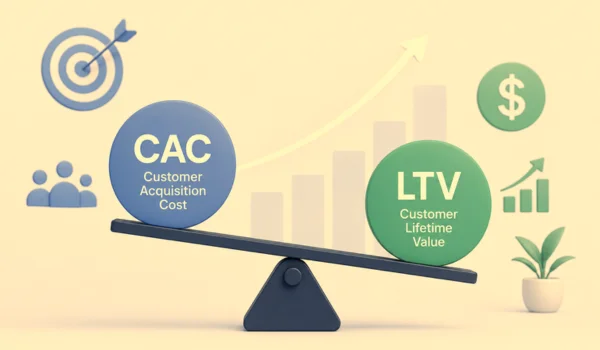
CAC measures how much a business spends to acquire a customer, while LTV estimates how much revenue or gross profit that customer can generate during the relationship.
Looking at these numbers together helps a company understand whether its growth is economically sustainable.
What Is Customer Acquisition Cost?
Customer Acquisition Cost is the average amount a business spends to acquire one new customer.
A basic calculation is:
CAC = Total Customer Acquisition Expenses ÷ Number of New Customers
For example, suppose a company spends ₹5 lakh on sales and marketing during a month and acquires 1,000 new customers.
Its approximate CAC would be:
₹5,00,000 ÷ 1,000 = ₹500 per customer
The expenses included in CAC can vary depending on how a company defines the metric. They may include advertising, sales salaries, marketing software, commissions and other acquisition-related expenses.
What Is Customer Lifetime Value?
Customer Lifetime Value estimates the economic value a customer can generate throughout their relationship with the business.
A simplified approach is:
LTV = Average Customer Revenue × Expected Customer Lifetime
For subscription businesses, companies may also consider gross margin and churn when calculating LTV.
For example, if a customer generates ₹1,000 per month and stays for an average of 24 months, the basic revenue-based LTV would be:
₹1,000 × 24 = ₹24,000
However, ₹24,000 is revenue, not necessarily profit.
A more useful analysis may consider the costs required to serve that customer.
Why CAC and LTV Should Be Compared
Looking at CAC alone does not tell you whether customer acquisition is financially attractive.
Suppose:
- CAC = ₹2,000
- Customer LTV = ₹10,000
The relationship could potentially be attractive.
But if:
- CAC = ₹8,000
- Customer LTV = ₹6,000
the company may be spending more to acquire customers than the economic value those customers generate.
This is why the CAC-to-LTV relationship matters.
The LTV:CAC Ratio
A commonly used metric is the LTV:CAC ratio.
For example:
LTV ÷ CAC = LTV:CAC ratio
If LTV is ₹12,000 and CAC is ₹3,000:
₹12,000 ÷ ₹3,000 = 4
The company has an LTV:CAC ratio of 4:1 under that calculation.
A higher ratio generally suggests that customer acquisition is more economically attractive.
However, an extremely high ratio is not automatically a sign of a perfect business. It could also indicate that the company is spending too little on acquisition and missing opportunities to grow.
Why a 3:1 Ratio Is Often Discussed
A 3:1 LTV:CAC ratio is frequently used as a general benchmark in startup and SaaS discussions.
It is sometimes interpreted as meaning that a business generates approximately three times as much customer lifetime value as it spends acquiring that customer.
But this should not be treated as a universal rule.
The appropriate ratio depends on:
- Industry
- Gross margins
- Business maturity
- Cash availability
- Growth objectives
- Customer retention
- Sales cycle
- Capital requirements
A young startup may deliberately operate with a lower ratio while investing heavily in growth.
Revenue LTV vs Profit-Based LTV
One important issue is that LTV can be calculated in different ways.
Suppose a customer generates ₹20,000 in revenue but the business spends ₹12,000 providing the product or service.
The business does not actually have ₹20,000 available as economic value.
Its gross profit is closer to:
₹20,000 − ₹12,000 = ₹8,000
Therefore, comparing CAC with gross-profit-based LTV can provide a more meaningful picture than comparing CAC with total revenue.
Why High LTV Does Not Always Mean a Good Business
A customer may theoretically have a high lifetime value, but that value might take years to realize.
For example:
- CAC = ₹10,000
- Expected LTV = ₹30,000
The ratio looks attractive.
But if the company needs three years to recover its acquisition cost, it may face significant cash-flow pressure.
This is where CAC payback period becomes important.
What Is CAC Payback Period?
CAC payback period measures approximately how long it takes for the gross profit generated by a customer to recover the cost of acquiring that customer.
Suppose:
- CAC = ₹6,000
- Monthly gross profit per customer = ₹1,000
The approximate payback period is:
₹6,000 ÷ ₹1,000 = 6 months
A shorter payback period can be especially valuable for businesses that need to preserve cash.
Retention Has a Major Impact
Customer retention directly affects LTV.
Imagine two companies with the same:
- Average monthly revenue
- CAC
- Initial customer acquisition rate
If customers of Company A remain for five years while customers of Company B remain for only six months, their lifetime values will be dramatically different.
This is why businesses often monitor metrics such as:
- Customer churn
- Retention rate
- Repeat purchase rate
- Average revenue per customer
- Expansion revenue
Improving retention can increase LTV without necessarily increasing acquisition spending.
Discounting Can Improve Customer Economics
Businesses often use discounts to attract new customers.
For example, a subscription normally costing ₹1,000 per month might be offered at ₹500 for the first three months.
This can reduce initial revenue and potentially affect LTV.
Discounts may still make sense if they significantly increase conversion and lead to long-term customers.
But excessive discounting can create a misleading picture of customer economics.
CAC Can Rise as a Business Grows
Acquiring the first 1,000 customers may be relatively easy.
A company may initially benefit from:
- Founder networks
- Organic search
- Referrals
- Early adopters
- Low advertising competition
As the company expands, it may have to target more expensive customer segments.
Advertising costs can increase, competition can become stronger and sales cycles can become longer.
Consequently, CAC should be monitored over time rather than calculated only once.
CAC vs LTV
| Metric | CAC | LTV |
| Full name | Customer Acquisition Cost | Customer Lifetime Value |
| Measures | Cost of acquiring customers | Economic value generated by customers |
| Main purpose | Measures acquisition efficiency | Measures customer economics |
| Affected by | Marketing and sales expenses | Revenue, retention and margins |
| Higher is generally | More expensive | More valuable |
| Key relationship | Compared against LTV | Compared against CAC |
What Happens When the Ratio Is Too Low?
A low LTV:CAC ratio can indicate that the company has a problem with its customer economics.
Possible reasons include:
- High advertising costs
- Low customer retention
- Low prices
- High service costs
- Poor conversion rates
- Weak customer loyalty
- Excessive discounts
The company may need to reduce acquisition costs, increase prices, improve retention or increase customer value.
What Happens When the Ratio Is Very High?
A very high ratio may look positive, but it can also reveal an opportunity.
Suppose a business has extremely strong customer economics but spends very little on marketing.
It might be able to invest more aggressively in customer acquisition while remaining profitable.
Therefore, the goal is not necessarily to achieve the highest possible LTV:CAC ratio.
The goal is to find a healthy balance between profitable growth and efficient customer acquisition.
Final Thoughts
Customer Acquisition Cost and Customer Lifetime Value provide a useful way to understand whether a company’s growth model makes financial sense.
CAC tells you what it costs to win a customer. LTV tells you what that customer can potentially contribute over time.
The relationship between the two helps businesses evaluate marketing efficiency, pricing, retention and long-term profitability.
However, the ratio should never be viewed in isolation. Cash-flow timing, gross margins, churn, payback period and the quality of the underlying assumptions all matter.
A business that continually acquires customers for less than the economic value those customers generate has a stronger foundation for sustainable growth.